
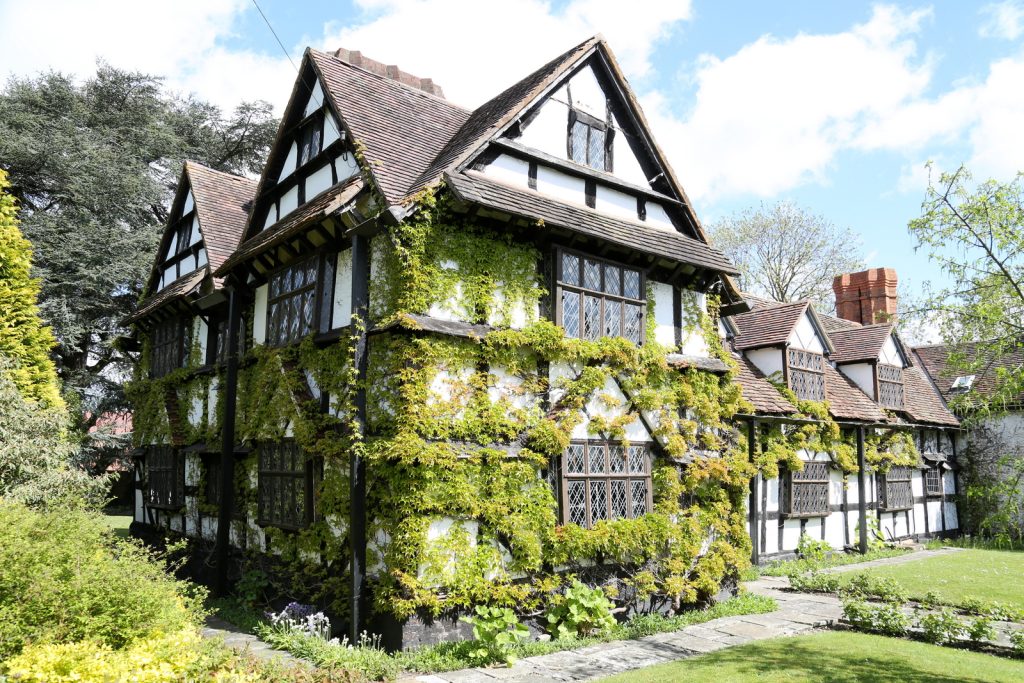
We get a lot of questions about restrictions to what you can do or cannot do to a Grade 2 Listed Building. These also apply to Grade 2* Listed Buildings and Grade 1 Listed Buildings as well – there are some general principles that you need to understand first.
Why is a building Listed?
A Grade 2 Listed building is Listed because it shows some form of significance. Whether this is design, or because of a person living there, or because it is a good example of local vernacular architecture, is not really relevant – but significance is one of the main reasons it will be Listed. The Listing, which is easily found by doing a map search (sometimes using postcode or name / address will fail, because houses and properties change quite a bit over the years) so look on the map search and you’ll find it – here: The List This will describe the building as it was Listed. It may not look like this, if it has been altered since – and any alterations need to be approved by your Local Authority (LA) Conservation department. Those changes are stored in the planning system, and you can search the planning records of your LA, to find any that relate to your building. The planning approvals or rejections will show detail of what was allowed. There is another website called British Listed Buildings – don’t use it because it is not up to date, and is not THE official record of Listed Buildings. I’ve had a recent Court case involving a FRICS Chartered Surveyor who used this as a reference – he got all his advice wrong and the client is suing him.
What can you do to a Grade 2 Listed Building?
Well – in theory, if you get permission, anything. It is getting permission that is the key.
What is ‘doing’? The law states that a ‘Material Change to a Listed Building’ must be approved. So, a material change taken literally, means that if you remove a paint covering and replace it with a different colour, it’s a ‘material change’. If you take off lime render and put cement render on, it is a ‘material change’. If you take off plaster internally, and re-plaster with gypsum, it is a ‘material change’. If you change a reed thatch for a long straw thatch, it’s a material change. In essence, if you change anything, either internally, or externally, you are doing something that needs permission and you are committing a criminal offence if you don’t get approval from the LA conservation officer first.
Repairs and Maintenance to a Grade 2 Listed Building
There is a grey area: Repairs and Maintenance are excluded from needing permission. However – these are to be minor in nature – re-painting the kitchen walls, re-painting the windows in grey paint if they are already grey. Minor repairs to timber frames – removal of an area of rot for example, and a face repair made properly. Taking apart an entire gable timber frame and rebuilding it is apparently NOT a repair, and needs conservation approval.
For the purposes of helping people understand the restrictions to working with Grade 2 listed buildings, or Grade 2* for that matter, you need to assume that anything other than very minor changes will require permission.
As an example, we recently had to help a client who had asked a builder to re-paint a timber frame. The builder cleaned all the flaky paint off the frame, found areas of rot, and brought in a carpenter to make repairs. A neighbour saw this and reported the client for illegal works. We were convinced the repairs were legal – the client was not making ANY changes, and the work was purely to repaint, and repair the frame. The LA conservation officer ruled that the work needed full Listed Building Consent, and we had to prepare a detailed schedule of repairs to each of the timbers, together with a specification of the jointing, the timber to be used, and the eventual finishes – together with a treatment of how we were to replace and repair the infil panels. So in this case, Grade 2 Listed Building restrictions turned out to be very onerous – and we feel unwarranted. However – the client got hte work done, it is legal, and the building has been correctly repaired. The application alone cost the client nearly £2000 – money which would be better spent on the building.
Working with your local Conservation Officer
So – there is a major problem with the rules – they are ‘interpreted’ differently by every Conservation Officer – some over zealous, and some not at all. There is a substantial problem with the system, and it is indeed unfair to a lot of Listed Building owners, and has undoubtedly cost building owners a lot of money and grief. My view is that it’s better to ask before you do anything – get to know your local Conservation Officer – they usually don’t bite – and most will be keen to help. Do remember though, they have no money, no resources, are financially presasured by their LA, many work part time. Personally I have a problem with a lot of them, because they are in the main Town Planners. They have little or no understanding of old buildings, or materials, and they are just pushing the law – so inevitably will demand a Listed Building Consent application – it generates income, creates work, and keeps them employed. There ARE LA’s that don’t work this way – by way of example, our Shropshire Council Conservation team is superb – and has a very active program of education and enlightenment for their Conservation staff. We work with them a lot, and always find them helpful and courteous.
We are often asked about Grade 2 listed building restrictions and Grade 2 listed building regulations. These are mostly covered in some of the other pages of the site, under specific topics – but we’ll summarise them again here. They apply to ANY listed building – whether Grade 2, or 1, or 2* Listed.
There is a useful publication from Historic England called ‘Making Changes to Historic Assets’ which is worth a read. Its very general, but it gives a few pointers worth knowing.
Restrictions are there to protect the historic significance of the building. Any change which affects the listed fabric of the building is illegal unless approved by your LA (Local Authority). Routine repairs and maintenance are excluded, so long as they are in like for like – and use materials sympathetic with the building. In other words, if you are to re-point for any reason, you cannot use cement – mortar must be closely matched to the mortar used in the original build. You can’t knock historic lime plaster off and replace it with gypsum – not only is this a material change, it will trap moisture and make the walls wet.
If you want, or need to make what are described as ‘Material Changes’ to the Listed fabric – for example taking a wall out to form an ensuite, removing a redundant chimney breast to enlarge a kitchen, you MUST apply for Listed Building Consent to the LA. The application will be reviewed by their Conservation Officer, who will assess the application for its impact on the Listed Fabric. Anything which negatively affects the signifcance of the heritage asset will be refused. Any material change will be very closely scrutinised – your application will be far more likely to succeed if it does not include material change, or minimises these.
For example – a new bathroom can be installed as a ‘cube’ within a cube of the old room. You could leave the original fireplace, and decorative plaster coving, and install a steel stud system to form a steel cube within the room, with pipework hidden behind the steel, and all the walls simply being fibre cement boarding screwed onto the steel stud. The bathroom is then tiled and finished, having almost no effect on the Listed fabric of the building. This application would be almost certainly approved. If you asked to remove the fireplace, and destroyed the coving – it would be refused.
Building regulations still apply to Listed Buildings. They are generally a little more relaxed – due consideration is given to the Listed Fabric – for example if fire regulations state that the staircase is too narrow or steep, the Listing will protect the staircase – another exit might have to be made – perhaps a big sash window with an escape ladder – but the Listing protects the asset.
We have put together some notes here on Building Regulations and Breathability in Listed Buildings:
Part L1B of the 2010 Building Regs:
http://www.planningportal.gov.uk/uploads/br/BR_PDF_ADL1B_2010.pdf .
The relevant paras are 3.6 to 3.13 (also reproduced in Part L2B). The most significant addition here is the recognition of “buildings of traditional construction with permeable fabric that both absorbs and readily allows the evaporation of moisture” (3.8c). Whilst not ‘exempt’, these fall under a category where “special considerations may apply”, i.e. “The work should not prejudice the character of the host building or increase the risk of long-term deterioration of the building fabric or fittings” (3.9)
These regulations are important:
a) there is recognition that traditional construction and longevity are important, as something additional to the more esoteric notions of historic character and appearance, and..
b) this does not only apply to designated heritage assets.
There are quite a few hurdles though: It is still only a case of ‘special circumstances may apply’; so your bog standard architect/builder/building control officer, can quite happily carry on as before. Our experience is that only where an architect/builder is already in the conservation field, that this comes into play, and it appears to be down to them to prove their case to Building Control rather than the other way around. That said, where Building Control are asked to consider an exemption, they are usually quite happy with a line or two from their conservation officer to confirm it accords with the LB Act etc.
The Regs state that English Heritage guidance should be taken into account (and there is now a good breadth of guidance from them), but the only specialist advisor referred to is the LA conservation officer. Two worries here: Most services are already overstretched; if the provision were universally put into practice the additional workload would be phenomenal (EH have a figure of around 20% of the building stock being pre-1919, and another 20% 1920-1939). LA Conservation Officers simple could not cope.
Then there is the fact that however much a conservation officer may know, they are not qualified to give structural advice over and above that of a structural engineer. Under LBC applications Conservation Officer friends have had many pointless arguments with structural engineers – at the end of the day, their qualifications have simply trumped theirs for structural issues. (EH, incidentally, has only one Structural Engineer to cover the entire country. Not much use on a day to day basis).
But, the introduction of the 3.8c category of building into the Building Regs does enormously strengthen the argument for traditional buildings to be given much higher priority throughout the building industry and education, and not just seen as a specialist and slightly cranky sideline.
Here’s a suggestion from a Conservation Officer friend:
Example of how to shut Building Control up, if its useful : “I confirm that the reinstatement of the timber-framed wall with brick infill, and single-glazed softwood casements, have been approved under Listed Building Consent 11/15068/LBC and are considered appropriate to retain and restore the special historic and architectural interest of the listed building in accordance with the Planning (Listed Buildings and Conservation Areas) Act 1990, British Standard BS 7913:1998, and the Building Regulations 2000 Part L 1B para 3.11. Likewise the internal lime plaster will reproduce historic finishes and ensure the building is maintained as a breathable structure in accordance with Part L 1B para 3.12.”) (They like regulations).
People very often jump to the conclusion a Conservation Officer is being difficult. They’re usually not – they just want to do things the right way – if you listen carefully, they are just trying to prompt you as to what to say, and how to make an application that will succeed. They became a CO for a reason usually – because they like old buildings!