
Damp… it’s not complicated
The Heritage House team get it. Ask a RICS surveyor and they haven’t a clue.
It’s all about the relationship between Temperature, The Absolute, and Relative Humidity. When you get the way this relationship works, you are well on the way to understanding ‘Damp’.
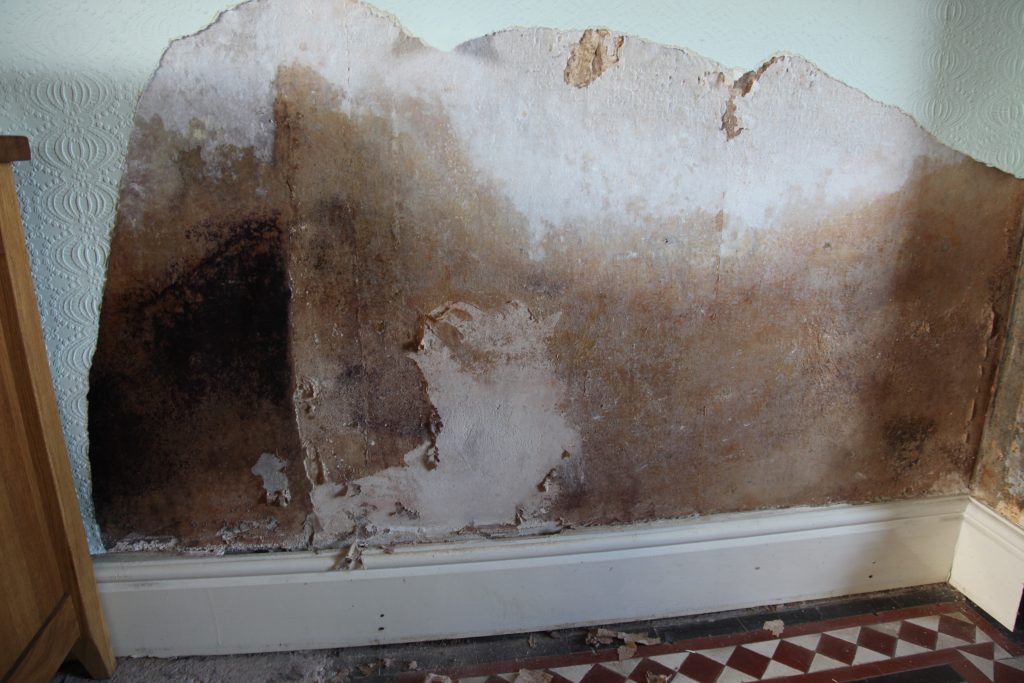
Ask anyone what they think of as ‘Damp’ in a building, and there will be many answers. They will include greenish mould, black mould spots on walls, flaking and bubbling paint, hollow and crumbling plaster, mouldy and smelly carpets, rotting floorboards and skirtings, smelly cupboards and strange odours from under floorboards and in cellars. Often there will be dark stains on walls, or a wet appearance to plaster. There may be fluffy white crystals on the walls. In houses that have had little very modern interference, gas fires produce their own characteristic peeling wallpaper and mouldy corners to the room. People describe condensation running down windows, and sometimes the walls themselves. In extreme cases, fungus develops on wet timber, and dry rot develops, with its characteristic sweet smell and white fungal growths that can envelop an entire cellar or sub floor. Houses often smell musty and can feel damp.
Timbers can exhibit ‘woodworm’ holes, little piles of yellow dust accumulate in cellars, entire beams can disintegrate into dust.
Fireplaces often look damp – dark patches and stains appear on the walls adjacent, staining appears on chimney breasts, wallpaper peels and plaster becomes crumbly and dusty at low level. Often bricks start to crumble and stonework in fireplaces disintegrates.
We are constantly reminded of ‘Damp’ by reference to Awaabs Law – a child who died of mould related problems in rented accommodation. Mould isn’t nice – but we hope you will gain from this website an understanding of WHY mould is there. You will learn to prevent it, with better heating and ventilation. Pete hates surveying in loft spaces, as often the insulation is thickly infested with mould, and it creates an allergic reaction.
The house may feel cold and damp. Occupants may experience frequent colds or flu, and succumb to bouts of asthma. Children are especially sensitive to such environments. A growing body of evidence supports the theory that a substantial proportion of asthmatic people these days have developed it through prolonged exposure to damp conditions at home. Allergic reactions to black mould can be quite serious.
Many homeowners and building professionals will have experienced some of these symptoms.
Almost every ‘damp problem’ that you can see, smell or feel is a symptom of an underlying cause. The real cause is seldom diagnosed by ‘damp experts’ and RICS surveyors who claim to ‘fix the damp’.
A mythology has built up around our lack of understanding of the causes of dampness. This is not helped by a public perception that old houses are invariably damp.
RICS Building surveys often state: ‘This is an old house – you should accept that you will always have to live with a certain amount of damp’. This is quite simply untrue. No house, whether old or new should ever be damp, or exhibit symptoms of dampness. They are not built with damp – we make them damp.
This website – alongside the Warm Dry Home book, is all about helping you to understand why problems occur with houses, and how to resolve them.