
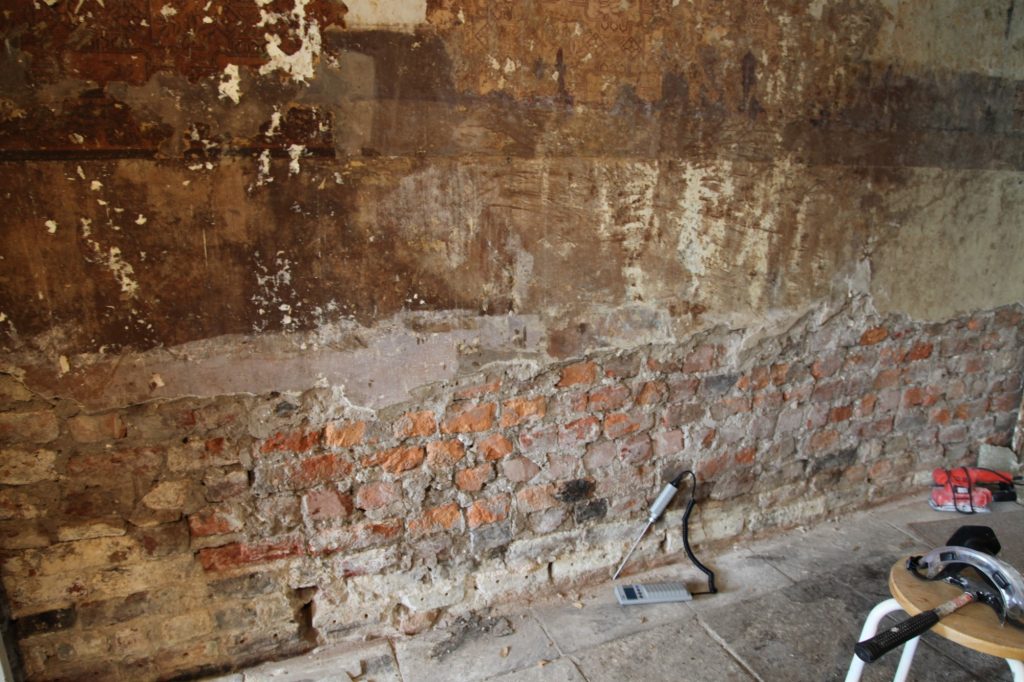
If you have a damp cellar, you are very lucky. It was built to be damp. It’s doing exactly what it was designed to do: Keep things cool and damp. That is… if you store wine, or want nice cool milk, or hang large hams from hooks in the ceiling after salting them.
Back in the days when it was built, they didnt have fridges, freezers and frozen food counters in the supermarket. So when dad brought home the bacon, that’s just what he did, and whopped it over a hook in the cellar, covered with a muslin bag to stay cool. He did the same with his bottles of beer, or cider. Mum would have a big bowl on the settlas which was made of pottery – glazed on the inside, like a plant pot on the outside. It stood in water, so it stayed damp, and evaporation of water from the pot kept the milk inside cool. They might have had a coal chute too, so food stored one side, coal the other. All very organised,
Nowadays, everyone wants basement damp proofing – if you have a big space downstairs that you can’t use, there is pressure to make it into a room. A damp basement isn’t a lot of use to anyone – if you store things down there, they get manky.
So what do you do?
Most cellars these days are damp. Properly damp and horrible. This comes down to a list of possible causes – each of which we need to investigate and tick off the list. Many cellars I see, are wet – there’s water either flowing or accumulating. A variety of sumps and pumps abounds. Think about it – in Victorian times they didnt have sump and pumps – they just dealt with any water, and certainly didnt build cellars that ran with water. If there WAS water involved, there was a good drainage system to remove it. So let’s look at the various things we find in cellars, and try to narrow things down a bit:
Water running or pooling in a cellar:
The first thing to note is that the cellar wasnt built that way. It would at the very least have had a land drain that took any water away from it. If there isn’t a drain in a corner somewhere, it was built as a dry cellar, and the old boys knew it wouldn’t flood. If you have water in a cellar – there are a lot of things you need to consider:
- Blocked or leaking storm drains
- High ground level pooling and sending water into cellar vents
- Excessive condensation dribbling off air conditioning or ventilation systems
- Leaking water supply pipes – often old lead mains.
- Blocked / leaking sewer pipes locally
- Blocked or leaking road drainage
- Rarely – but we’ve seen it – interference with the water table from new housing or road developments
There are ways to figure out which of these are the problem. Not always, but sometimes, you can characterise the water through chemistry. Rainwater has a different chemical signature to water from a leaking water main. If you have persistent water in a cellar, you need to dig a little sump, clear it out, keep cleaning it – until we know that the water in that sump is fresh, and will reflect its origins. A sump can just be a bucket sunk into the ground to hold water, and something you can bale out if needs be. Once we know that there is a constant flow of water from wherever, we take a sample, and keep taking them for a week or two – using clean, sterile sampling bottles. These then need to be sent to a good water laboratory that can analyse them for trace chemistry. Most environmental labs know their local water supply and can get hold of the analyses of the water from the supplier on a daily basis. If yur sample has very high nitrates for example, it may well be showing a sewage source. This could be confirmed with bacterial analysis. If it is from road drainage that is broken, which it often is – then it’ll be contaminated with some of the following:
Main Contaminants Found in Road Runoff
- Heavy Metals: Zinc, copper, lead, cadmium, nickel, and iron come from vehicle brake pad dust, tire wear, and engine/metal corrosion. Copper and zinc frequently exceed safe environmental thresholds for aquatic life.
- Hydrocarbons and Oil Products: Polycyclic aromatic hydrocarbons (PAHs), such as pyrene and benzo(a)pyrene, along with petrol, diesel, lubricating oils, and hydraulic fluids, wash off leaky vehicles and asphalt surfaces.
- Microplastics & Tire Particles: Microscopic rubber fragments and synthetic polymers shed from car and truck tires, plus worn road markings, form a major component of particulate pollution.
- Total Suspended Solids (TSS): Undissolved silt, soil, road dust, asphalt particles, and debris bind other chemicals and cloud riverbeds, suffocating fish eggs and aquatic plants.
- De-icing Salts & Chemicals: Road salts (sodium chloride) applied during winter weather alter the salinity, chemistry, and biological balance of receiving streams and groundwater.
- Nutrients & Pathogens: Fertilizers, animal waste bacteria, and organic litter wash from surrounding curbs and green spaces into the drainage network.
- PFAS, VOC’s: Per- and polyfluoroalkyl substances (“forever chemicals”) have increasingly been identified in modern stormwater and highway runoff studies.
All of these chemicals are easy to detect if needed.
If groundwater is suspected, we need to test for the following:
| Parameter Category | Key Chemicals & Metrics | Primary Diagnostic Purpose |
|---|---|---|
| Major Ions | Ca²⁺, Mg²⁺, Na⁺, K⁺, HCO₃⁻, Cl⁻, SO₄²⁻ | Identifies aquifer geology, water hardness, and salinity. |
| Physicochemical | pH, EC, TDS, Alkalinity, DO, ORP | Establishes baseline water stability and metal solubility. |
| Nutrients | Nitrate, Nitrite, Ammonia, Phosphate | Detects fertilizer runoff, livestock waste, and sewage leaks. |
| Heavy & Trace Metals | Arsenic, Lead, Iron, Manganese, Chromium, Fluoride | Screens for toxic bedrock minerals and industrial waste. |
| Organics & PFAS | VOCs, TPH, PAHs, Pesticides, PFOA, PFOS, TFA | Pinpoints fuel spills, chemical solvents, and synthetic runoff. |
A broken water main will contain a slice of these, but they will form a much clearer ‘scan’ of chemicals that form a ‘fingerprint’ of the local water supply.
Ventilation:
Most cellars were used as a store for wood and coal as well as food. These were usually dumped in through a ‘coal chute’. Over the years, most coal chutes have become redundant, and are just holes in walls, often blocked with an array of bricks, bits of timber, iron grilles, metal bars or 40 gallon oil drums. The net result is usually a hole in the ground that water runs into, and then cascades down into the cellar.
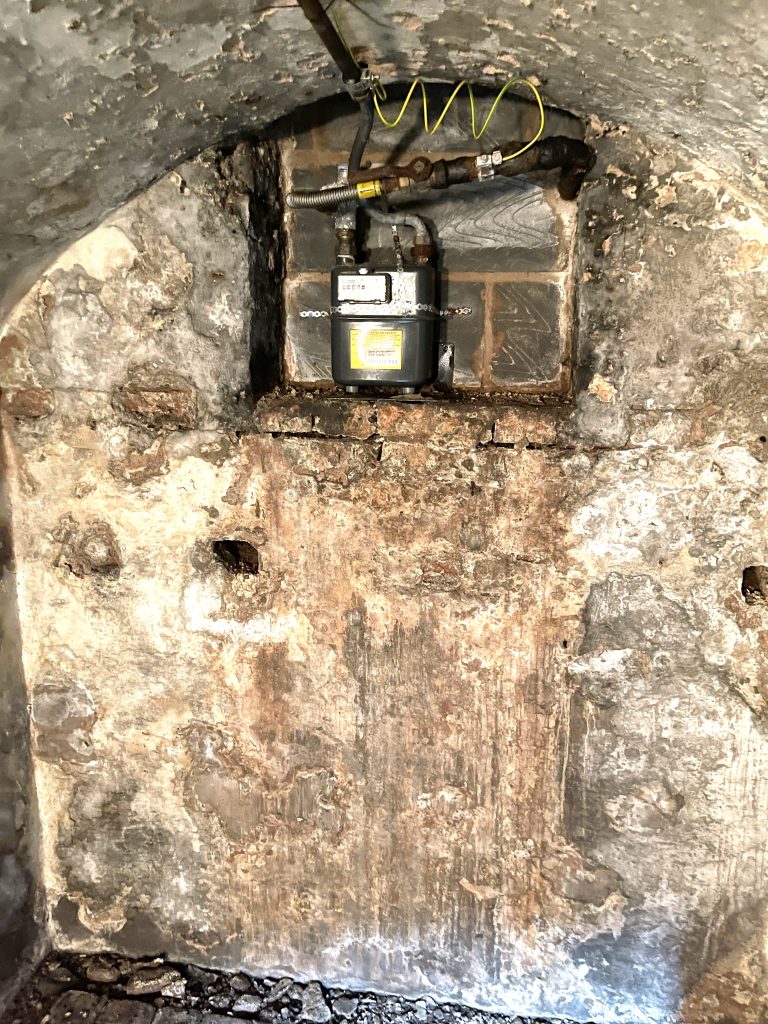
A typical blocked coal chute, forming a handy spot for a gas meter sitting on permanent wet stonework. You can see where rain pours in through the hole and soaks the wall. The hole has been bricked up, preventing any air flow in the cellar. All the rainwater that runs in then tries to evaporate, creating a damp, wet and cold environment and causing damp issues in the house above.
Well the first thing is to ventilate it. You need a good through flow of air – I’ll bet it isn’t at the moment. Humidity controlled extraction should make sure it stays dry. You need dry air from the house to be drawn in – so it keeps the place nice and dry. You need to make sure there aren’t any modern materials on the wall – like plastic masonry paints, cement render, gypsum plaster – because they will all fall off and create the inevitable symptoms of ‘rising damp’
If you REALLY can’t get it dry enough like this, then you may have to go for extreme measures like using a framing system, or a commercial cavity drain system. We can investigate and advise on your options – but ventilation and opening it up are always first on our list, and inexpensive too!
In the last 10 years, Pete has not once had to tank or damp proof a cellar or basement. Always, there is a way to dry it out – inevitably using good humidity controlled ventilation. You will notice a difference in your house too – reduced levels of moisture in the basement will mean a warm dry house above it.