
This is the content of an enquiry we received recently. It’s part of a worrying trend we are seeing, which comes back to one thing – a greedy chemical industry trying to sell chemicals that are never needed:
“I have had a quote from a seemingly reputable stone masons to fix up an old circa 1890s cottage in the Yorkshire dales that’s had a mixture of Portland cement repointing done and one wall that a neighbour has kindly painted in white masonry paint. They have said all the right stuff to me regarding repointing in lime and will conduct sampling to ensure they use the correct strength for the stone. But they have also said they will spray the finished stone with breathable microporous sealant. They have referenced Haloseal and Balzona for me to research. Is this recommended? It seems to be becoming a trend from my research online. Thanks for everything Peter, all your info has genuinely helped me along my old property journey!”
Breathable Microporous Sealants… ?
Have a read of the title here – does it not sound a little crazy? Breathable, yet a sealant? This is a very simple problem – the chemical industry wants to sell chemicals. Houses don’t need their rubbish. Old houses have stood, often for centuries, in fine fettle – and then all of a sudden, they are suffering (according to the chemical industry that is..) from all sorts of problem. Why would you seal stonework? People think you should seal stonework because they have visions of water pouring into it – well if water really did pour through the stone, the house would have been wet for hundreds of years – and yet it hasn’t been. It probably DOES have problems – flaking stone, and damp mortar – but all that is because we have been shoving impermeable stuff like cement, paint and silicone on to the walls – which then traps moisture into the stone and makes it fail.
Breathability – yup – that means allowing water vapour to pass. Just like those ‘breathable’ raincoats you get that allow sweat to wick away, but supposedly stop the rain. There’s one problem – what happens when sweat turns to liquid – its trapped and can’t get through. There’s another problem. Most manufacturers these days say their stuff is ‘breathable’. It’s a buzz-word. But how do they test it? Ask them and you won’t get a response. Often they have a BBA certificate. Saying its breathable. Ask BBA (We did) what their test methodology is. Apparently its ‘commercial confidential’. Hmm – so would you take drugs that were supposed to do something for you that didnt disclose any test methodology? Hmm – we thought not. Almost all paints sold on the market these days have one form or another of ‘breathable’ version – yet none of them will disclose their methodology.
We had a look at the website that sells Haloseal – it reads like a catalogue of everything you Do Not Do to a house – they’ve got insulating wallpaper (guaranteed to create trapped condensation problems), balloons you stick up chimneys (reduce heat loss up chimneys it says… and create huge problems with lack of ventilation into the bargain!), Pliolite masonry paint (apparently it must resist the elements: wind-driven rain, sun, temperature extremes and atmospheric pollution, whilst at the same time retaining its decorative appearance – oh yeah – and trap moisture into the wall whilst we are at it.. I’ve come across pliolite a lot – and it’s crap. You have to peel the damn stuff off in sheets to let walls dry out. Don’t use it! There’s dozens of other products that are all just about guaranteed to cause major issues with breathability and condensation. There’s references to mould all over the site. Clearly this bloke makes a living out of mould. Nowhere on the site is there a reference to preventing it by reducing moisture content – its all about sealing things!!! Avoid this site and products like the plague.
Belzona – oh dear – the website talks exclusively about polymers and polymerics – baiscally they sell plastic coatings. On a wall, believe me, its something you dont want. I’ve come across some of their waterproof roofing systems, and they are quite good as a substitute for example for flat roofs, replacing manky old bitumen. Just don’t get sucked into using plastic coatings to ‘waterproof’ your wall – if you do, it will then end up trapping interstitial condensation.
Stormdry masonry paint
The biggest vendor of these things in the UK at the moment is a company called Safeguard – who make all manner of toxic chemicals. Their biggest seller is Stormdry masonry paint – which seals brickwork and stone. Far from stopping water getting INTO the wall, it stops any from getting OUT. The inevitable result is that stone or brick then starts to disintegrate. We know – we’ve tested it on walls at Heritage House HQ on the soft sandstone. It was a disaster. The stone started to break up after a year or so.
English Heritage did research on these things too. Their conclusions? NEVER use any form of masonry sealant.
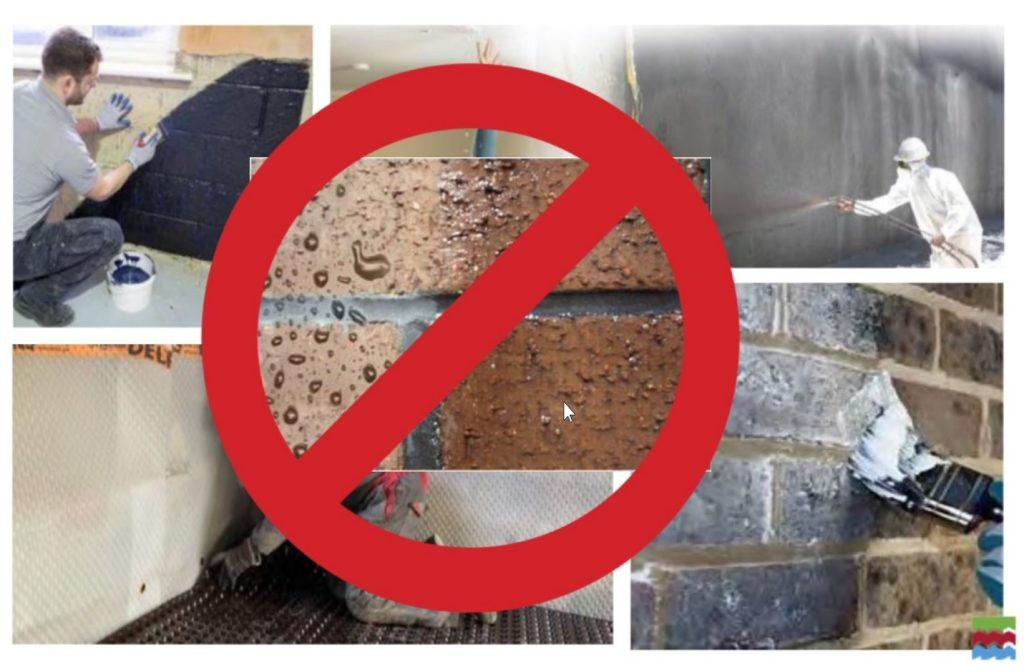
English Heritage webinar photo – “Don’t ever use surface treatments!”
Courtesy Dr. Robyn Pender.