
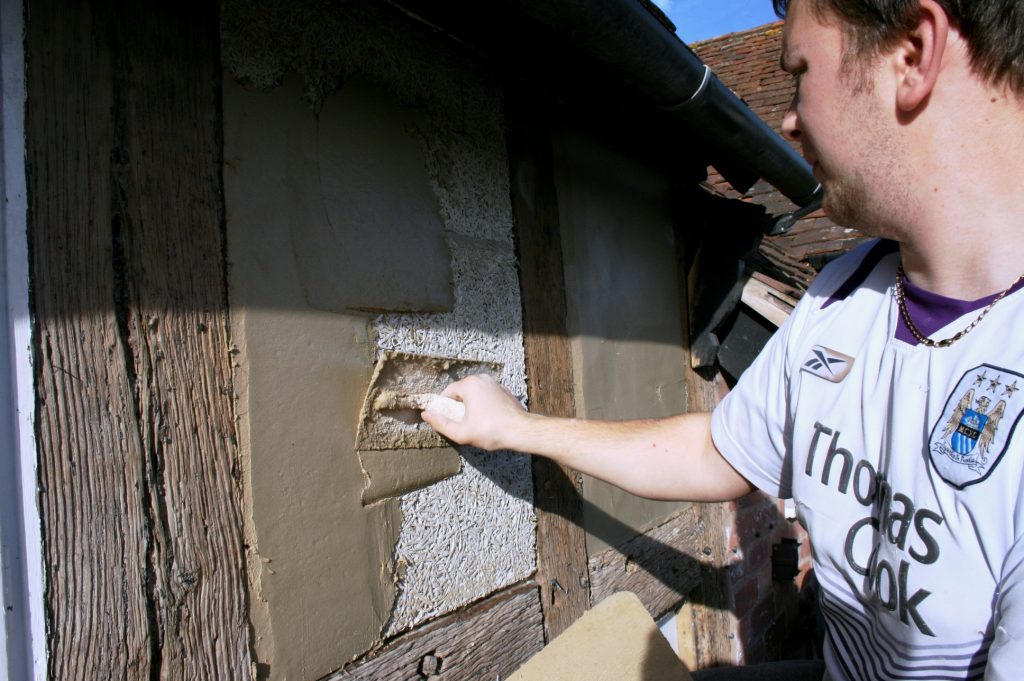
Lime is one of the oldest building technologies still commonly used. It was used extensively by the Romans, and is found in nearly all buildings built before the early 1900’s. It is essential to use lime if you are restoring a building that was originally constructed with lime.
Most modern building materials are made using portland cement, which is hard, rigid and impervious. Lime allows a structure to breathe – it is porous, and flexible. It allows water to escape the building. Any fine cracks which develop will self heal, as opposed to cement, which just cracks and lets water in.
Building with lime is a process that is simple, yet needs understanding. Lime is a lovely material to use, it is very forgiving, and inexpensive. Once you understand the material, and how it works, using it within your home will become a pleasure.
Lime terminology can be confusing – so here is a breakdown of the types of lime. The most important thing to realise is that most builders do NOT understand lime – so when you ask for lime mortar, they may say ‘yes we can do lime’ – meaning that they add a shovelful of builders lime to a bucket of cement. This is NOT what we mean by lime mortar or plaster/ render!
Essentially the lime that we use today falls into three broad categories:
NHL limes
Natural Hydraulic Lime (NHL) mortars used to be favored in conservation and traditional building because they achieve a dual “set” – first chemically with water, then with air. This makes them highly reliable in damp or exposed conditions compared to traditional non-hydraulic lime putties. They can be mixed like cement, and used in a similar way. It is partly the reson that lime mortar has had a reasonably rapid ‘take-up’ with many otherwise unskilled builders.
NHL’s are now not very popular because we know that they continue to harden and become less breathable over time. So if your builder or architect specifies NHL limes, question the reason for this – it is probably because neither of them understand lime properly. If, for example, you are re-pointing your lovely soft red brick with an NHL, you might as well use cement. Over time, the NHL will become nearly as hard and unbreathable as cement, and you will have wasted a lot of time and effort, not to mention money, for all the wrong reasons.
Manufacturing process:
NHL is manufactured from naturally “impure” limestone that contains inherent deposits of clay, silica, and aluminates. These impurities in the limestone turn into chemicals known as Alites and Belites when burned in the furnace.
In the study and application of lime mortars, Alites and Belites are the primary mineral phases responsible for hydraulicity—the ability of a mortar to set and harden under water or in the absence of air.
While traditional pure “air limes” rely entirely on atmospheric carbon dioxide to harden over centuries (carbonation), Natural Hydraulic Limes (NHLs) and modern blended mortars rely on the hydration of these calcium silicate phases. However, Alite and Belite function very differently due to how they are produced and the rate at which they develop strength.
Comparison of Alite and Belite
| Characteristic | Belite (C₂S) | Alite (C₃S) |
|---|---|---|
| Chemical Name | Dicalcium Silicate (Ca₂SiO₄) | Tricalcium Silicate (Ca₃SiO₅) |
| Kiln Temperature | Formed at 950°C – 1200°C | Formed only above 1260°C – 1300°C |
| Primary Presence | Natural Hydraulic Limes (NHLs) | Portland Cement (OPC) / Strong Blends |
| Reaction Rate | Slow and progressive (months to years) | Rapid (hours to days) |
| Role in Strength | Long-term strength & reducing breathability | Early structural strength |
1. Belite (C₂S): The Backbone of Hydraulic Lime Mortars
Belite is the predominant hydraulic component found in true Natural Hydraulic Limes (NHL 2, 3.5, and 5). Because traditional lime kilns operate at lower temperatures (under 1200°C), the silica impurities in the limestone fuse with calcium oxide to form dicalcium silicate rather than tricalcium silicate.
- The Hydration Process: When mixed with water, Belite slowly hydrates to form Calcium Silicate Hydrate (C-S-H) gel and crystalline calcium hydroxide (portlandite).
- Slow, Long-Term Curing: Belite is highly unreactive during the first few days. It contributes very little to initial setting but continues to hydrate and gain strength progressively over months and years.
- Preserving Vapor Permeability: Because Belite develops its crystalline structure slowly, it allows the mortar to retain an open pore structure. This is crucial for historic building conservation because it ensures the mortar remains breathable and flexible, allowing moisture to escape the masonry rather than trapping it.
2. Alite (C₃S): The Fast-Setting Agent
Alite is the main driver behind the rapid strength development of modern Ordinary Portland Cement (OPC) and high-temperature formulations. True, traditional NHLs contain virtually no Alite because the required burning threshold (>1260°C) is not reached. If Alite is present in a historic lime mortar, it usually indicates either an over-fired batch, an ancient “engineered” pyro-mortar, or modern cement contamination.
- Rapid Initial Set: Alite reacts fiercely with water, dominating strength development within the first 7 to 28 days.
- High Density and Low Porosity: Alite produces significantly more calcium hydroxide byproduct during hydration than Belite does. This rapid rush of C-S-H gel and portlandite quickly blocks the capillary networks within the mortar. While this grants immediate compressive strength, it drastically lowers the mortar’s breathability and elasticity.
Burning: Raw, impure limestone is quarried and fired in a kiln at roughly 900°C to remove carbon dioxide, turning it into quicklime. During this intense burning process, the clay minerals react with the calcium to form hydraulic chemical compounds (silicates and aluminates). The calcium rich limestone itself is converted to Calcium Oxide (quicklime).
Slaking: Hot quicklime is then slaked (combined with a strictly controlled amount of water) to convert the material into a dry calcium hydroxide powder. The water content is calculated precisely so that the hydraulic compounds remain unreacted until mixed on-site.
Grading: The final dry powder is categorised into standard compressive strength grades based on its percentage of clay impurities:
NHL 2 (Feebly hydraulic; lowest clay; soft/sheltered masonry)
NHL 3.5 (Moderately hydraulic; standard masonry and general pointing)
NHL 5 (Eminently hydraulic; highest clay; extreme weather exposure)
Shortcomings of NHL Mortars
While NHL is far more breathable and flexible than modern Portland cement, it has several documented shortcomings – particularly when compared to traditional, pure non-hydraulic lime putty or quicklime based mortars.
- Long-Term Hardening: Unlike pure air limes, NHLs continue to slowly gain strength long after the standard 28-day curing mark. Over years or decades, they can become excessively brittle and hard.
- Reduced Breathability: As NHL finishes curing and continues to density over time, its vapor permeability drops. NHL 5, in particular, has a significantly tighter pore structure that blocks dampness from escaping as easily as pure lime putty.
- Risk to Historic Masonry: Because a wall naturally moves, the mortar must always be weaker than the surrounding brick or stone. If a strong NHL grade (like NHL 3.5 or 5) is mistakenly applied to very soft, historic brick or crumbling sandstone, the mortar will eventually become harder than the stone. This causes the masonry itself to spall and fracture around the joints. This is also a problem with breathability – moisture cannot escape as easily, so blows its way out of the surrounding stone or brickwork.
- Strict Curing Demands: NHL mortars require highly specific conditions to cure properly. They must stay consistently damp for several days after application to achieve their hydraulic set, but they cannot tolerate freezing temperatures, rapid drying winds, or heavy rain during the initial cure. They then need damp conditions to continue to carbonate.
Putty Based mixes
Putty-based lime mortar (also known as non-hydraulic or “air lime” mortar) is a traditional, highly breathable building material primarily used for the conservation and repair of historic buildings. Unlike modern cement or natural hydraulic limes (NHL), it sets exclusively by absorbing carbon dioxide from the air (carbonation) in the presence of water.
Putty-based lime mortar contains three basic ingredients:
Lime Putty: The binder, made from pure calcium hydroxide.
Aggregate: Typically clean, sharp, well-graded angular sand.
Water: Minimal extra water is added, as the putty itself carries enough moisture.
It can also contain fibres for increased strength – normally used when making plasters and renders.
Manufacture:
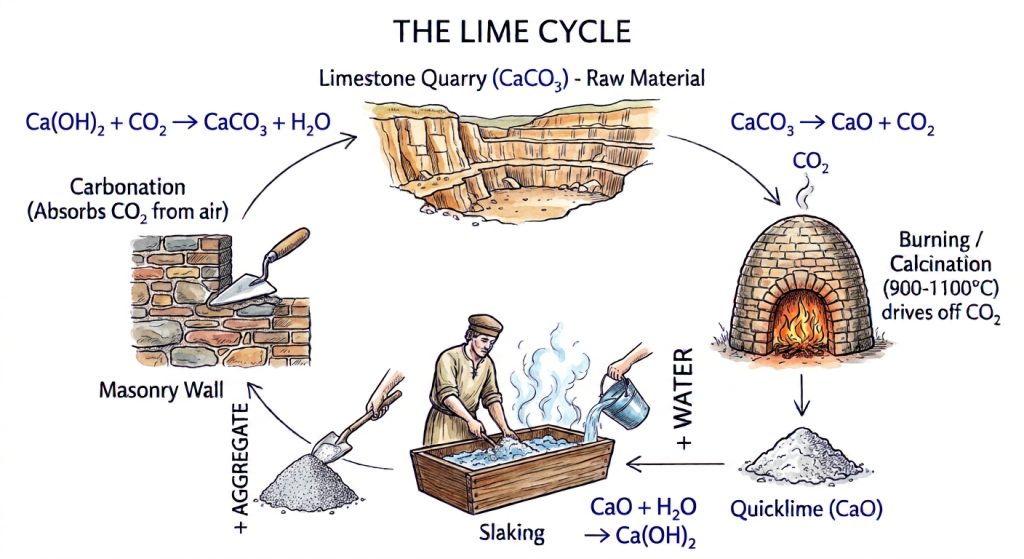
The creation of lime putty follows a chemical cycle known as the Lime Cycle:
- Burning (Calcination): Pure limestone or chalk (calcium carbonate) is heated in a kiln to around 900°C–1000°C. This drives off carbon dioxide, leaving behind highly reactive quicklime (calcium oxide).
- Slaking: Quicklime is immersed in an excess of water. This triggers a violent, heat-releasing (exothermic) chemical reaction that turns the quicklime into a thick, creamy liquid slurry.
- Maturing: The slurry is left to mature in pits or containers for at least 2 to 3 months (and often longer). As it ages, it forms a rich, putty with microscopic particle structure that makes it highly workable.
- Mixing: The matured lime putty is mechanically knocked up and blended with sand to create the final mortar.
Shortcomings & Limitations
While excellent for flexibility and breathability, putty-based lime mortars have distinct disadvantages:
- Extremely Slow Set: Because it relies entirely on air exposure to carbonate, it hardens exceptionally slowly. It can take months to achieve full strength.
- Weather Sensitivity: It cannot be used in cold or freezing weather. Applying it below 5°C to 10°C risks frost damage, which will completely destroy the mortar before it sets. It also requires protection (such as damp hessian) from drying out too fast in the sun or wind.
- Low Initial & Overall Strength: It has the lowest compressive strength of all lime types. It is unsuitable for structural foundations, below-ground applications, or heavy load-bearing zones.
- Failure in Damp/Deep Joints: If used in deeply recessed masonry joints or persistently wet environments, air cannot reach the center of the mix. Without carbon dioxide, the inner mortar will fail to set and stay soft indefinitely.
- High Shrinkage Risk: If mixed too wet or with poorly graded sand, it is highly prone to shrinking and cracking as water evaporates.
Quicklime mixes, known as Hotlime
Quicklime-based lime mortars (often referred to as hot-mixed lime mortars or fat lime mortars) are traditional materials that have been used in masonry for thousands of years. They are highly valued in historic building conservation due to their flexibility, extreme breathability, and self-healing properties. They make superb plasters and renders when combined with fibres for strength and insulation. Quicklime mortars consist of three primary ingredients:
- Quicklime (Calcium Oxide, CaO): The active binder, created by burning high-calcium sedimentary rocks like limestone, chalk, or seashells.
- Aggregate: Usually sharp sand, though historic mixes often included crushed stone, brick dust, or clinker to alter performance and colour.
- Water: Triggers the chemical reaction that converts the unstable quicklime into a usable paste.
Production of quicklime mortar follows the traditional lime cycle:
Burning (Calcination): Raw limestone (calcium carbonate) is heated in a kiln to around 900°C–1000°C. This drives off carbon dioxide gas, leaving behind highly reactive lumps or powder known as quicklime.
Slaking (Hydration): The quicklime is mixed directly with water and damp sand. This triggers an intense, spontaneous exothermic (heat-releasing) reaction. The mixture vigorously steams and boils, reaching temperatures over 250°C at the core, breaking the quicklime down into calcium hydroxide. You can’t mix it in a plastic tub!
Mixing & Application: The violent heat expands the lime paste, wrapping it tightly around the sand grains to form an incredibly sticky, workable “hot-mixed” mortar.
Curing (Carbonation): Unlike modern cement, which sets chemically via water, non-hydraulic quicklime mortar sets by absorbing carbon dioxide from the air, in the presence of water. It slowly reverts back into calcium carbonate – essentially turning back into stone over months and years. It’s like this: CO2 + Ca(OH)2 → CaCO3 + H2O
Shortcomings and Limitations
Despite their structural and conservation benefits, quicklime mortars have several distinct drawbacks:
- Extreme Health and Safety Hazards: Quicklime is highly alkaline and caustic. When it hits moisture (including sweat or eyes), it reacts violently and can cause chemical burns and respiratory damage. Powdered forms also create dangerous airborne plumes during mixing.
- Slow Setting Time: Because it relies entirely on atmospheric CO₂ to harden, the carbonation process is incredibly slow. It can take weeks to develop initial strength and months to cure fully.
- Vulnerability to Weather and Frost: Because it stays damp and soft for a long time, fresh quicklime mortar needs care – keep out of rain, and keep covered.
- Poor Deep-Wall Carbonation: Air and water must reach the mortar for it to harden. In incredibly thick historic walls or deep masonry joints, the lack of oxygen means the core of the mortar can remain soft and un-carbonated for extended periods of time.
- Low Compressive Strength: Quicklime mortars are physically soft. They cannot handle heavy engineering loads or high-stress environments without adding hydraulic agents (like pozzolans or volcanic ash).
- Risk of “Pop-outs”: If using “kibbled” (lumpy) quicklime, some larger pebbles might fail to slake fully during the initial mix. Weeks later, they can slowly absorb moisture inside the wall, expand, and blow off the face of the finished mortar joints. This is more pronounced in render and plaster finishes. It’s why when mixing, you can’t use a builders mixer – you need a horizontally mounted paddle mixer that is left for at least an hour to achieve a good even mix.
Builders Lime
There is a 4th Category of lime – the stuff they sell in builders yards. This is largely ignored as being unsuitable for work that requires lime mortar. It is different to the limes described above, in that it is fired at higher temperatures in cement making facilities. It is a pure white hydrated lime, which provided it is kept perfectly dry and sealed from the air, CAN be used to make mortar. However, most has started to carbonate before it gets anywhere near a mortar. The bags are not totally sealed from CO2 in the air, nor totally from water. It was designed to be used as a plasticiser for cement mortar – not for making mortar mixes in its own right. We don’t recommend using this to make lime mortar, or for pointing – it simply won’t be hard enough to do anything.