
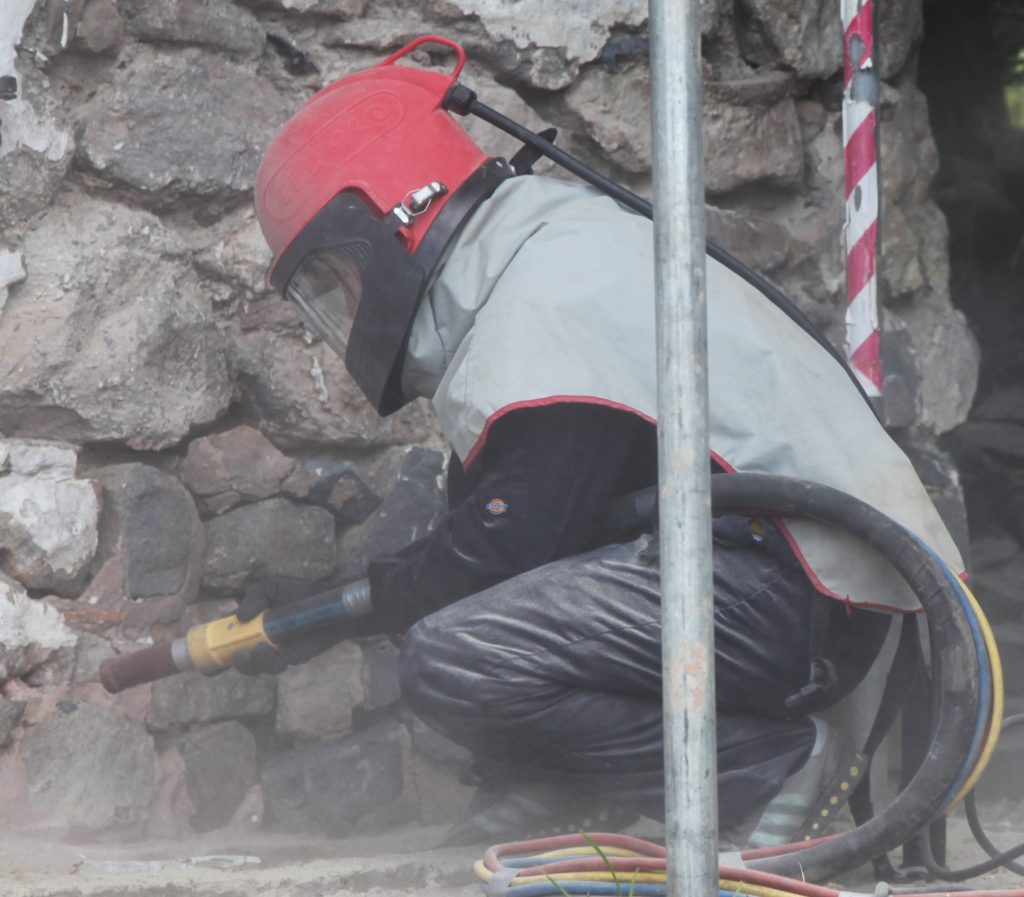
Many old houses have horrible plastic “masonry paint” covering the brickwork. In the past, removal has been almost impossible. These days, high temperature pressure washers allow plastic paint removal – and other methods can then be used to remove distempers and lime based paints to reveal clean historic brickwork. These methods do not damage the face of bricks.
Methods use equipment such as Doff and Torq – or Toriq..
It is important to ensure that cleaning does not affect the glaze on the surface of bricks – if this is damaged, moisture can get into the brick and cause spalling. This is why grinders or mechanical means, including sandblasting, are not a good idea.
Sand-Blasting is often used by operators who don’t understand the damage it can do to surfaces. In particular, sandblasting of bricks causes serious damage – it removes the delicate and very thin ‘glaze’ on the surface of the brick, leaving it open to the weather. Moisture soaks into the brick, and can rapidly begin to cause spalling and flaking. The only solution to badly sandblasted brickwork or stone, is usually to lime render the entire elevation affected, so that it gains a protective coating. Sandblasting can help in some situations – but usually only when used with grits that are softer than the material being cleaned. Material such as dolomite, a soft carbonate, coconut shell, or in some cases dry ice, can help clean stone or brick (sometimes with timber as well). It is vital to do a small test area first – do NOT allow a contractor to just run uncontrolled over the walls of your home without assessing the impact of what they are doing. Any work of this kind being done to a Listed Building, will inevitably need Listed Building Consent.